
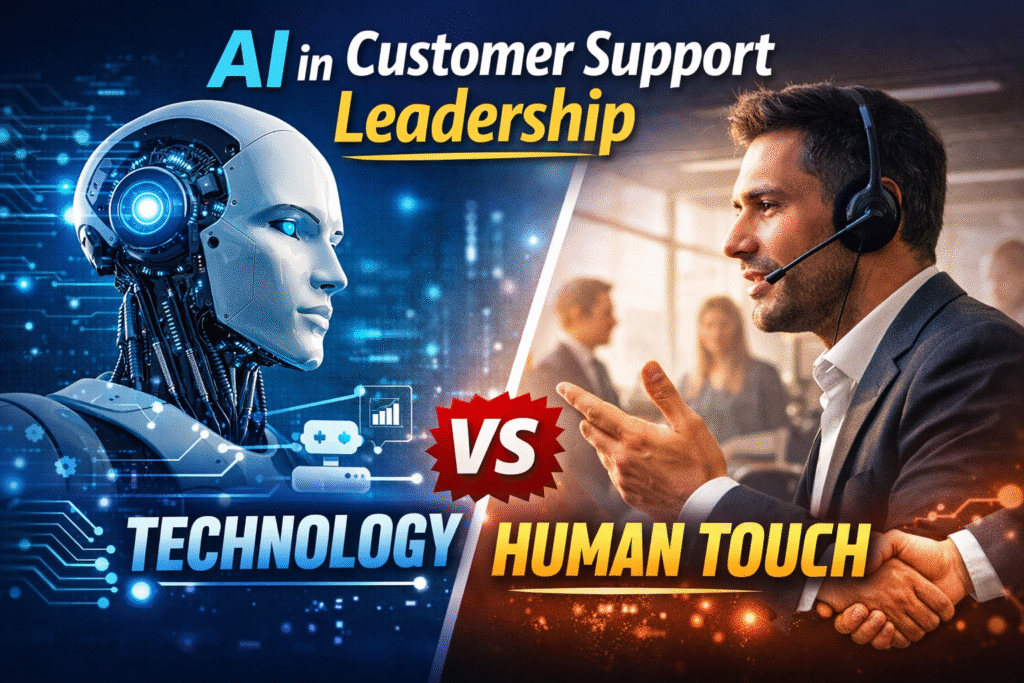
On a Friday evening at 8:47 PM, just minutes before peak ticket sales for a major live event, the system went down.
Within seconds, the dashboard turned red.
Tickets were piling up.
Chats were exploding.
A high-value client called — furious.
“Do you know what this outage just cost us?”
The AI system immediately went to work.
It tagged the sentiment as “Highly Negative.”
It pulled up historical ticket data.
It suggested a professional apology template.
It predicted churn probability at 62%.
Impressive.
But it couldn’t do what happened next.
The Head of Customer Support picked up the phone.
He didn’t read from a template.
He didn’t reference churn probability.
He listened.
He understood the client wasn’t just angry about downtime — they were afraid. Afraid of losing credibility. Afraid of refunds. Afraid of social media backlash.
He took ownership.
He escalated internally.
He coordinated with Product.
He offered compensation strategically.
He stayed on the call until trust was restored.
The AI helped.
But leadership saved the relationship.
And that’s the difference.
AI Is Transforming Support — But It’s Not Replacing Leadership
There’s no denying it.
Artificial Intelligence is revolutionizing customer support:
- Chatbots handling Level 1 queries
- AI-driven sentiment detection
- Automated ticket routing
- Forecasting models for staffing
- Self-service knowledge optimization
AI in Customer Support Leadership is becoming a powerful accelerator.
But here’s the real question:
Can AI replace customer support leadership?
The answer is no.
Because leadership operates in areas where data ends — and human judgment begins.
The Night the Dashboard Said “Reduce Staff”
A month later, analytics showed something interesting.
Late-night ticket volume had dropped by 18%.
The AI recommendation was clear:
“Reduce staffing between 1 AM and 4 AM to optimize cost.”
Financially, it made sense.
But the support leader paused.
The company’s positioning was built around 24×7 human support. Many clients operated in different time zones. And some of the highest-value enterprise clients used late-night hours for pre-event setup.
Instead of reducing staff, the leader asked deeper questions:
- Why is volume dropping?
- Is self-service improving?
- Are customers struggling silently?
- Are we entering a new market?
After reviewing patterns, he discovered something else — customers were avoiding chat because they assumed no one was available.
So instead of cutting costs, the team improved visibility of live support availability.
Volume stabilized.
Retention improved.
Brand promise stayed intact.
AI suggested efficiency.
Leadership protected positioning.
When an Agent Almost Quit
AI dashboards flagged an issue.
One agent’s CSAT score dropped from 96% to 82% in two months.
The system highlighted “Performance Risk.”
But the support leader didn’t just review metrics.
He sat with the agent.
He listened to call recordings.
He noticed hesitation in tone.
Confidence gaps.
After a conversation, he learned the agent felt overwhelmed after handling multiple escalations during a system outage.
It wasn’t incompetence.
It was burnout.
With coaching, mentoring, and gradual exposure to complex cases, the agent not only recovered — but later became a team lead.
AI identified the problem.
Leadership built the solution.
AI can monitor productivity.
Leaders build people.
The Internal War No Dashboard Can Fix
One afternoon, Sales closed a large deal.
They promised a custom feature that Product had not approved.
Within weeks, tickets surged.
Clients were frustrated.
Support was overwhelmed.
Product felt blindsided.
AI summarized ticket themes.
It categorized complaints.
It predicted escalation risk.
But resolving the issue required something else:
Negotiation.
Political intelligence.
Cross-functional alignment.
The support leader arranged a three-way meeting.
He protected the customer’s interest.
He aligned internal expectations.
He set realistic timelines.
He prevented future misalignment.
That wasn’t automation.
That was organizational leadership.
Where AI Stops — And Leadership Begins
AI thrives on structure.
But leadership operates in ambiguity.
Consider crisis moments:
- A public social media backlash
- A legal compliance update
- A sudden outage
- A competitor undercutting pricing
AI can draft communication.
AI can analyze sentiment.
But deciding:
- What to communicate
- When to communicate
- How transparent to be
- What long-term impact to consider
That requires intuition, ethics, and courage.
AI optimizes for efficiency.
Leaders optimize for trust.
The Real Fear: Not AI Replacing Leaders — But Leaders Misusing AI
Here’s the uncomfortable truth.
AI will not replace customer support leaders.
But leaders who don’t understand AI might replace themselves.
Because the future is not AI vs Humans.
It’s AI + Human Leadership.
And that’s where many organizations struggle.
They either:
- Over-automate and lose human touch
- Or underutilize AI and become inefficient
The balance requires mastery.
How the AI Mastery Program Helps Build an AI-Powered Support Center
This is exactly why the AI Mastery Program was created.
Not to replace leaders.
But to empower them.
The program helps customer support leaders:
1. Design an AI-Enabled Support Center
- Identify repetitive tickets for automation
- Implement smart routing systems
- Set up AI-assisted agent dashboards
- Build self-service ecosystems
2. Improve Efficiency Without Losing Human Touch
- Decide what should be automated
- Define escalation triggers
- Maintain human intervention in high-emotion cases
- Balance cost optimization with brand positioning
3. Use AI for Strategic Decisions
- Predict churn patterns
- Identify upsell opportunities
- Detect operational bottlenecks
- Forecast workforce requirements
4. Create AI-Augmented Agents — Not Replaced Agents
Instead of replacing agents, the program teaches how to:
- Equip agents with AI response suggestions
- Use sentiment analytics to improve coaching
- Build performance dashboards that drive growth
- Turn data into development conversations
The goal isn’t to remove humans.
It’s to remove friction.
The Future Belongs to Leaders Who Understand Both Sides
Customer support leadership today requires two capabilities:
- Emotional Intelligence
- AI Intelligence
One without the other creates imbalance.
If you rely only on emotion — you lose scalability.
If you rely only on AI — you lose humanity.
The strongest leaders are those who:
- Use AI to enhance decision-making
- Use data to coach teams
- Use automation to remove repetitive work
- Use human judgment where trust is at stake
Recommended Learning & Certification
🎓 Become a Highly Efficient Customer Support Team Leader
In order to learn more about how to become a highly efficient Customer Support Team Leader then please enroll to this on-demand course:
🎓 Instructor-Led Certification Program
You can also enroll in the TCCSS Instructor-Led Certification:
👉 https://thecustomersupportschool.com/training-certification/

Govindraj Shetty is a customer support and success leader with over 19 years of experience across global organizations. He has built and scaled high-performing support and customer success teams, most notably at Yapsody, where he established departments and programs that consistently delivered strong customer satisfaction and client retention.
He is a trainer, Udemy instructor, and founder of The Customer Support School, and the author to customer support books.
