
Introduction
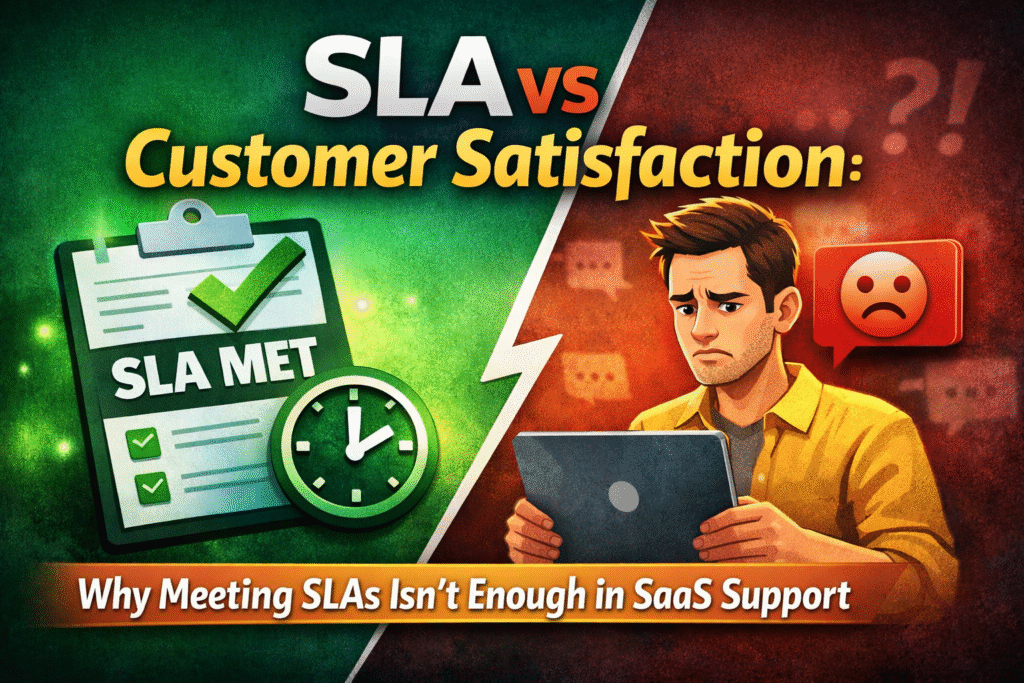
In SaaS organizations, Service Level Agreements (SLAs) are often treated as the backbone of customer support performance. Teams are trained, measured, and incentivized to meet response time and resolution benchmarks. However, a recurring challenge across many SaaS companies is this: even when SLAs are consistently met, customers still report dissatisfaction. This disconnect highlights a critical gap between internal performance metrics and actual customer experience. Understanding the dynamics of SLA vs Customer Satisfaction is essential for any organization focused on retention and long-term revenue growth.
What SLAs Actually Measure
SLAs are designed to bring structure and predictability to support operations. Common SLA metrics include:
- First Response Time (FRT)
- Resolution Time
- Ticket Closure Rate
- Availability/Uptime Commitments
These metrics are operational in nature. They help teams ensure that no ticket goes unanswered and that issues are resolved within a defined timeframe. From a management perspective, SLAs provide a clear benchmark for accountability and workforce planning.
However, SLAs primarily measure speed and compliance, not quality or effectiveness.
The Gap: SLA vs Customer Satisfaction
Customer satisfaction is influenced by a broader set of factors that go beyond speed:
- Was the issue resolved completely?
- Did the customer need to follow up multiple times?
- Was the response personalized and relevant?
- Did the support agent take ownership?
- Was the communication clear and proactive?
A support team may respond within 30 minutes (meeting SLA), but if the response is templated, vague, or requires additional clarification, the customer perceives the experience as poor.
This is where the gap in SLA vs Customer Satisfaction becomes evident. SLAs measure effort from the company, while satisfaction reflects value received by the customer.
Real-World SaaS Example
Consider a real-world scenario in an event ticketing SaaS platform:
An event presenter is setting up ticket sales for a high-demand event and encounters an issue with payment gateway configuration. They reach out to support.
- The support team responds within 1 hour (SLA met).
- The response includes a generic help article link.
- The customer tries the steps but still faces issues.
- They reply again and wait another few hours.
- A second agent responds with partial clarification.
- The issue finally gets resolved after multiple back-and-forth interactions over 24 hours.
From an SLA standpoint:
- Response times were within limits.
- The issue was resolved within the allowed timeframe.
From the customer’s standpoint:
- The process was time-consuming.
- The urgency of the event was not acknowledged.
- The support experience lacked ownership and proactiveness.
Result: Low satisfaction despite SLA compliance.
Why Meeting SLAs Is Not Enough
There are several structural reasons why SLAs alone fail to ensure customer satisfaction:
1. Focus on Speed Over Quality
Support teams often prioritize quick responses to meet SLA targets. This can lead to:
- Incomplete answers
- Over-reliance on templates
- Lack of deep problem understanding
2. Fragmented Ownership
When multiple agents handle the same ticket, customers feel a lack of continuity. Even if each interaction meets SLA, the overall experience feels disjointed.
3. Lack of Contextual Understanding
Customers expect support teams to understand their use case. Generic responses fail to address specific business scenarios, especially in SaaS platforms where configurations vary.
4. Reactive Instead of Proactive Support
SLAs are inherently reactive—they measure how quickly you respond after a problem occurs. Customers, however, value proactive guidance that prevents issues in the first place.
5. Misaligned Metrics
Organizations often tie performance incentives strictly to SLA adherence. This creates behavior where teams optimize for metrics rather than customer outcomes.
Metrics That Complement SLAs
To bridge the gap between SLA vs Customer Satisfaction, SaaS companies must track additional metrics:
- Customer Satisfaction Score (CSAT): Measures immediate feedback post-interaction
- Customer Effort Score (CES): Evaluates how easy it was for the customer to resolve the issue
- First Contact Resolution (FCR): Tracks whether the issue was resolved in a single interaction
- Net Promoter Score (NPS): Reflects overall customer loyalty
- Reopen Rate: Indicates unresolved or poorly handled tickets
These metrics provide a more holistic view of customer experience.
Strategies to Align SLAs with Customer Satisfaction
1. Redefine Success Metrics
Shift from SLA-only targets to a balanced scorecard:
- 40% SLA adherence
- 30% CSAT
- 20% FCR
- 10% qualitative feedback
This ensures teams focus equally on speed and quality.
2. Improve First Response Quality
Train agents to:
- Understand the issue before responding
- Provide actionable, step-by-step solutions
- Anticipate follow-up questions
A slightly slower but high-quality first response often reduces overall resolution time.
3. Enable Ticket Ownership
Assign a single owner for complex issues. This improves:
- Accountability
- Context retention
- Customer trust
4. Invest in Knowledge Management
Build a structured knowledge base that:
- Is easy to navigate
- Includes real use-case scenarios
- Is regularly updated based on support trends
5. Proactive Communication
For critical issues:
- Acknowledge urgency
- Provide regular updates
- Set clear expectations
Even if resolution takes time, proactive communication significantly improves perception.
6. Use Customer Context in Responses
Leverage CRM and product usage data to:
- Personalize responses
- Understand customer goals
- Provide relevant solutions
Role of Customer Success Teams
Customer Success (CS) teams play a crucial role in bridging the SLA gap. While support teams handle immediate issues, CS teams focus on:
- Onboarding and education
- Proactive engagement
- Identifying potential risks
- Driving product adoption
For high-value customers, a coordinated approach between Support and CS ensures that issues are not just resolved but prevented.
Leadership Perspective: Operational vs Experience Metrics
From a leadership standpoint, the goal should be to align operational efficiency with customer outcomes.
Key actions include:
- Regularly reviewing SLA vs CSAT trends
- Conducting root cause analysis on low CSAT tickets
- Incorporing customer feedback into product and process improvements
- Avoiding over-reliance on SLA dashboards
Leaders must recognize that SLAs are a means to an end, not the end itself.
Conclusion
The challenge of SLA vs Customer Satisfaction is not about choosing one over the other but about aligning both. SLAs ensure discipline and consistency, while customer satisfaction reflects true value delivery. SaaS companies that go beyond SLA compliance—focusing on resolution quality, ownership, and proactive engagement—are better positioned to retain customers and drive long-term growth. Ultimately, customers do not remember how fast you responded; they remember how effectively you solved their problem.
Take the Next Step in Your Leadership Journey
Addressing the gap between SLA vs Customer Satisfaction requires more than process changes—it demands strong leadership within support teams. Leaders play a critical role in shifting the focus from SLA compliance to delivering meaningful customer outcomes. This includes coaching teams on quality responses, driving ownership, and building a culture centered on customer experience.
At The Customer Support School (TCSS), we’ve created a complete certification program designed to manage your staff effectively.
Customer Support Team Leader Certification – TCSS
You’ll learn how to:
- Manage support KPIs effectively
- Coach team members with confidence
- Run impactful team rituals
- Transition smoothly from agent to leader
- Set goals, deliver feedback, and build trust
Prefer learning at your own pace?
You can also take the Udemy version of this course, perfect for self-paced learners: Support Team Leader Mastery Bestseller Course on Udemy.
It’s packed with real-world examples, leadership templates, and proven coaching frameworks.Remember:
“Leadership is not about being in charge. It’s about taking care of those in your charge.” Ready to lead with clarity, confidence, and capability?
[Get Certified Now] and fast-track your support leadership career.

Govindraj Shetty is a customer support and success leader with over 19 years of experience across global organizations. He has built and scaled high-performing support and customer success teams, most notably at Yapsody, where he established departments and programs that consistently delivered strong customer satisfaction and client retention.
He is a trainer, Udemy instructor, and founder of The Customer Support School, and the author to customer support books.
