
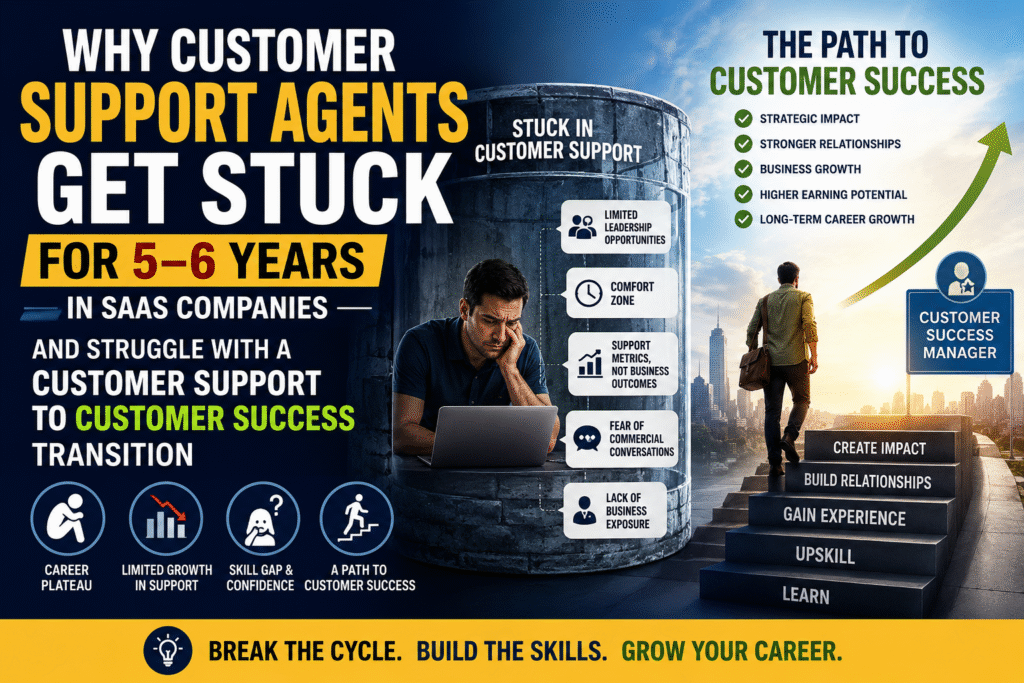
Introduction
The Customer Support to Customer Success Transition has become one of the most discussed career moves in the SaaS industry. As subscription-based software companies continue investing in retention, product adoption, and customer growth, many organizations naturally look toward their customer support teams when hiring Customer Success Managers.
Support professionals often possess deep product knowledge, strong customer empathy, and years of experience helping customers solve problems. On paper, they appear to be ideal candidates for Customer Success roles.
Yet a surprising number of support professionals spend five to six years in customer support without successfully making a Customer Support to Customer Success Transition.
The challenge is rarely a lack of intelligence or dedication. Instead, a combination of organizational limitations, career structures, skill gaps, and mindset barriers often prevents talented support professionals from advancing into Customer Success roles.
The Growing Demand for Customer Success Professionals
The rise of SaaS has transformed how companies grow revenue. Instead of relying solely on acquiring new customers, businesses now focus heavily on retaining and expanding existing accounts.
As a result, Customer Success teams have become responsible for:
- Product adoption
- Customer retention
- Churn reduction
- Customer engagement
- Expansion opportunities
- Customer advocacy
This increased focus on retention has made the Customer Support to Customer Success Transition an attractive career path for support professionals seeking long-term growth.
However, while many companies encourage this transition, not all support professionals successfully make the move.
Research Finding #1: Limited Leadership Opportunities in Customer Support Create Career Stagnation
One of the most overlooked reasons behind the need for a Customer Support to Customer Success Transition is the limited career progression available within many SaaS support organizations.
Most customer support departments operate using a pyramid structure. While a company may have dozens of support agents, there are usually only a few Team Lead positions, one Support Manager, and perhaps a single Head of Customer Support role.
A typical support organization may look like this:
- 20 Customer Support Agents
- 3 Support Team Leads
- 1 Support Manager
- 1 Head of Customer Support
This structure means that not every support professional can advance into leadership, regardless of performance or experience.
Many support agents spend years mastering:
- Product knowledge
- Customer communication
- Troubleshooting skills
- Escalation management
- Process improvement
However, leadership opportunities remain limited because:
- Management positions open infrequently.
- Existing leaders often remain in their roles for several years.
- Support departments typically grow slower than Customer Success and Sales.
- Organizations may not require additional support management layers.
As a result, many professionals reach a career plateau after five to six years.
This reality is one of the key drivers behind a Customer Support to Customer Success Transition. Rather than waiting for a management position to become available, support professionals can pursue strategic customer-facing roles that offer broader responsibilities and stronger long-term career prospects.
Research Finding #2: Comfort Zone Becomes a Career Trap
A major challenge in the Customer Support to Customer Success Transition is that support professionals often become highly comfortable in their existing role.
After years of handling customer issues, they become experts in:
- Troubleshooting
- Product functionality
- Escalation management
- Support processes
This expertise creates confidence but can also create resistance to change.
Many support professionals believe their product knowledge alone qualifies them for Customer Success. However, Customer Success requires a different mindset focused on business outcomes rather than issue resolution.
The transition from reactive problem solving to proactive customer growth is often more difficult than expected.
Research Finding #3: Support Metrics Do Not Develop Success Skills
Many SaaS organizations measure support teams using operational metrics.
Examples include:
- Customer Satisfaction Score (CSAT)
- First Response Time
- Resolution Time
- Ticket Backlog
- Ticket Quality Scores
These metrics encourage operational excellence but do little to prepare professionals for a Customer Support to Customer Success Transition.
Customer Success teams focus on entirely different outcomes:
- Retention rates
- Product adoption
- Customer health scores
- Expansion revenue
- Renewal success
- Churn prevention
A support agent can spend years excelling in support metrics without ever learning how Customer Success teams drive business growth.
Research Finding #4: Fear of Commercial Conversations
Many support professionals delay a Customer Support to Customer Success Transition because they mistakenly believe Customer Success is primarily a sales role.
They become uncomfortable with discussions involving:
- Renewals
- Upselling
- Expansion opportunities
- Pricing discussions
- Business reviews
In reality, Customer Success is not traditional sales.
The goal is to help customers achieve measurable business outcomes. Revenue growth typically follows when customers realize value from the product.
Developing confidence in commercial conversations is a critical step in the transition.
Research Finding #5: Limited Executive Communication Experience
Support agents typically interact with:
- End users
- Administrators
- Technical contacts
Customer Success Managers frequently communicate with:
- Founders
- CEOs
- Vice Presidents
- Directors
- Business decision makers
A successful Customer Support to Customer Success Transition requires professionals to learn how to communicate with executive stakeholders.
These conversations focus on business outcomes, return on investment, customer goals, and strategic planning rather than technical troubleshooting.
Research Finding #6: Lack of Customer Lifecycle Visibility
Customer support teams usually become involved when problems occur.
Customer Success teams manage the entire customer journey.
A Customer Support to Customer Success Transition requires understanding:
- Sales handoff
- Onboarding
- Product adoption
- Customer engagement
- Renewals
- Expansion opportunities
- Customer advocacy
Because support professionals often interact with customers only during support requests, they may have limited exposure to the broader customer lifecycle.
Research Finding #7: Organizational Dependency
Many high-performing support professionals unknowingly become victims of their own success.
Organizations rely on them for:
- Complex escalations
- Training new agents
- Process improvements
- Quality assurance
- Knowledge management
Managers often hesitate to move these individuals into Customer Success because replacing them can be difficult.
Ironically, the stronger a support professional performs, the harder their Customer Support to Customer Success Transition may become.
Research Finding #8: Missing Business Acumen
Perhaps the most important barrier in a Customer Support to Customer Success Transition is the lack of business knowledge.
Support professionals typically focus on:
- Product functionality
- Technical troubleshooting
- Process execution
Customer Success professionals focus on:
- Customer retention
- Product adoption
- Business outcomes
- Revenue protection
- Growth opportunities
A successful transition requires professionals to understand how customers achieve business value and how SaaS companies generate recurring revenue.
Without this business perspective, even highly experienced support agents may struggle to succeed in Customer Success roles.
Industry Statistics Supporting the Customer Support to Customer Success Transition
The growth of Customer Success is not a temporary trend. It is a direct result of how SaaS businesses generate revenue.
Historically, software companies focused heavily on acquiring new customers. However, recurring revenue models have shifted attention toward customer retention and expansion.
Industry research consistently shows that:
- Acquiring a new customer is significantly more expensive than retaining an existing one.
- Small improvements in retention can have a major impact on long-term profitability.
- Existing customers often represent the largest source of expansion revenue.
- SaaS investors increasingly evaluate companies based on retention metrics and Net Revenue Retention (NRR).
As a result, SaaS organizations have expanded investments in:
- Customer Success
- Customer Education
- Customer Onboarding
- Customer Experience
- Adoption Programs
This shift has created more opportunities for professionals pursuing a Customer Support to Customer Success Transition.
Unlike support organizations, which often scale based on ticket volume, Customer Success organizations continue growing as companies focus on reducing churn and increasing customer lifetime value.
For support professionals, this represents one of the strongest long-term career opportunities in the SaaS industry.
Real-World SaaS Examples of Customer Support to Customer Success Transition
Many leading SaaS companies actively recruit Customer Success Managers from customer-facing departments.
Example 1: HubSpot
Support professionals at HubSpot often develop deep product expertise through customer interactions.
Many employees later transition into:
- Customer Success
- Onboarding
- Account Management
- Customer Training
This allows the organization to retain valuable product knowledge while creating career growth opportunities.
Example 2: Zendesk
Zendesk has historically encouraged internal mobility across customer-facing teams.
Support professionals who understand customer challenges frequently move into:
- Customer Success
- Professional Services
- Customer Education
- Solutions Consulting
The company benefits because these professionals already understand customer behavior and product adoption challenges.
Example 3: Salesforce
At Salesforce, customer-facing employees often build careers across multiple departments.
Support specialists frequently expand into:
- Success Management
- Adoption Consulting
- Strategic Account Management
The organization recognizes that customer empathy and product knowledge create a strong foundation for future Customer Success leaders.
These examples demonstrate that a Customer Support to Customer Success Transition is not unusual. In many SaaS companies, it is viewed as a natural career progression path.
Why Some Support Professionals Choose Not to Pursue a Customer Support to Customer Success Transition
While many professionals aspire to move into Customer Success, others intentionally remain in support.
This decision is often based on personal preferences rather than a lack of ambition.
Some support professionals enjoy:
- Technical troubleshooting
- Product expertise
- Structured workflows
- Immediate problem-solving
- Operational excellence
Customer Success introduces responsibilities that may not appeal to everyone, including:
- Strategic planning
- Executive stakeholder management
- Commercial conversations
- Revenue discussions
- Customer portfolio management
For some professionals, becoming a senior support specialist can be a highly rewarding career path.
The purpose of a Customer Support to Customer Success Transition is not to suggest that Customer Success is superior to support. Instead, it provides an additional pathway for professionals seeking broader business exposure and long-term career growth.
Salary Differences Between Customer Support and Customer Success Roles
One factor driving a Customer Support to Customer Success Transition is compensation growth.
While salaries vary by geography, company size, and experience level, Customer Success roles often provide higher earning potential because they directly influence retention and revenue outcomes.
A typical career progression may look like:
| Role | Relative Compensation |
| Customer Support Agent | Entry Level |
| Senior Support Agent | Moderate Growth |
| Support Team Lead | Moderate Growth |
| Customer Success Manager | Significant Growth |
| Senior Customer Success Manager | Higher Growth |
| Strategic Customer Success Manager | Premium Compensation |
| Customer Success Director | Leadership Compensation |
In addition to salary increases, Customer Success roles often provide exposure to:
- Strategic customers
- Executive stakeholders
- Revenue conversations
- Business planning
- Leadership opportunities
These experiences can accelerate long-term career development.
Self-Assessment Checklist: Are You Ready for a Customer Support to Customer Success Transition?
Use the following questions to evaluate your readiness.
Customer Mindset
- Do you enjoy understanding customer business goals?
- Do you naturally think beyond solving tickets?
- Do you enjoy helping customers achieve outcomes?
Business Awareness
- Are you interested in retention and churn?
- Do you understand how SaaS companies generate revenue?
- Are you curious about customer lifetime value?
Communication Skills
- Are you comfortable presenting ideas?
- Can you communicate with decision-makers?
- Can you explain business value instead of technical features?
Relationship Building
- Do you enjoy building long-term customer relationships?
- Can you manage multiple stakeholders?
- Do customers frequently seek your guidance?
Growth Mindset
- Are you willing to learn new business skills?
- Are you open to commercial discussions?
- Are you comfortable leaving your support comfort zone?
Scoring
- 12–15 Yes Answers: Strong candidate for a Customer Support to Customer Success Transition.
- 8–11 Yes Answers: Good foundation with development opportunities.
- Below 8 Yes Answers: Focus on building business and relationship management skills before transitioning.
Case Study: From Support Agent to Customer Success Manager
Consider the example of Clint Dsouza, a support professional working at a mid-sized Event ticketing SaaS company.
Clint Dsouza spent 5 years in customer support.
He consistently achieved:
- High CSAT scores
- Low escalation rates
- Strong product expertise
Despite his performance, leadership opportunities were limited.
The support department consisted of:
- 15 Support Agents
- 2 Team Leads
- 1 Support Manager
Clint Dsouza realized he could spend several more years waiting for a management opening.
Instead, he began preparing for a Customer Support to Customer Success Transition.
Over the next 12 months, he:
- Participated in onboarding calls
- Shadowed Customer Success Managers
- Learned SaaS retention metrics
- Conducted customer business reviews
- Studied adoption and churn management
Eventually, he moved into a Customer Success Manager role.
Within two years, he became responsible for:
- Customer retention
- Adoption planning
- Executive business reviews
- Strategic account management
His success did not come from additional product knowledge.
It came from expanding her business skills beyond traditional support responsibilities.
Recommendations for SaaS Leaders
Organizations that want to encourage a successful Customer Support to Customer Success Transition should create structured career development programs.
Create Transparent Career Paths
Clearly define:
- Support Agent
- Senior Support Agent
- Customer Success Manager
- Senior Customer Success Manager
Employees should understand what skills are required at each stage.
Introduce Cross-Functional Exposure
Allow support professionals to participate in:
- Onboarding sessions
- QBRs
- Renewal discussions
- Adoption reviews
This helps employees understand the broader customer lifecycle.
Provide Customer Success Training
Support teams should receive training in:
- Retention strategy
- Customer health scoring
- Adoption management
- Business communication
Encourage Internal Mobility
Many organizations hire externally for Customer Success positions while overlooking internal talent.
Creating formal transition programs can:
- Reduce hiring costs
- Improve retention
- Increase employee engagement
- Preserve product knowledge
Reward Strategic Thinking
Support professionals should be recognized not only for ticket resolution but also for:
- Customer outcome improvements
- Adoption recommendations
- Process optimization
- Customer advocacy
This encourages behaviors that support a future Customer Support to Customer Success Transition.
Essential Skills Required for a Customer Support to Customer Success Transition
Professionals seeking a Customer Support to Customer Success Transition should focus on developing:
Strategic Thinking
- Customer success planning
- Risk identification
- Long-term customer outcomes
Customer Health Analysis
- Adoption monitoring
- Churn prediction
- Engagement tracking
Executive Communication
- Business reviews
- Stakeholder management
- Outcome-focused conversations
Commercial Awareness
- Renewals
- Expansion opportunities
- Revenue retention
Relationship Management
- Building trust
- Managing multiple stakeholders
- Long-term partnership development
Building a Successful Customer Support to Customer Success Transition Roadmap
Phase 1: Learn SaaS Business Fundamentals
- Retention
- Churn management
- Product adoption
- SaaS metrics
Phase 2: Master Customer Success Methodologies
- Success planning
- QBRs
- Health scoring
- Lifecycle management
Phase 3: Improve Business Communication
- Executive presentations
- Strategic discussions
- Value-based conversations
Phase 4: Gain Practical Experience
- Participate in onboarding
- Support renewals
- Join adoption initiatives
Phase 5: Develop Leadership Skills
- Account management
- Cross-functional collaboration
- Customer advocacy
Choose Your Learning Path
Option 1 — On-Demand Learning (Flexible & Self-Paced)
Designed for professionals who want a structured Customer Support to Customer Success Transition roadmap.
This program provides:
- Step-by-step modules
- SaaS case studies
- Proven templates
- Customer Success frameworks
- Self-paced learning
Customer Success Manager Mastery Program – On-Demand
Enroll here:
Udemy Course – Customer Success Manager Mastery Program
https://www.udemy.com/course/customer-success-manager-mastery-program/?referralCode=6AA6334F9FAFB1CA31F5
Option 2 — Instructor-Led Program (Live Coaching & Accountability)
Designed for professionals seeking guided support throughout their Customer Support to Customer Success Transition.
This program includes:
- Live coaching
- Cohort-based learning
- Real-world problem solving
- Accountability tracking
- Personalized feedback
Customer Success Manager Mastery – Instructor-Led Program
Join here:
https://thecustomersupportschool.com/tcss-customer-success-manager-mastery/
Final Takeaway
The Customer Support to Customer Success Transition is one of the most valuable career moves available within the SaaS industry.
However, many professionals remain stuck in support roles because of limited leadership opportunities, comfort-zone expertise, operationally focused metrics, lack of executive communication experience, organizational dependency, and insufficient business acumen.
The good news is that these barriers can be overcome through intentional learning, practical experience, and a structured development plan.
As SaaS companies continue prioritizing retention, adoption, and customer growth, professionals who complete a Customer Support to Customer Success Transition will position themselves for greater responsibility, stronger earning potential, and long-term career success.

Govindraj Shetty is a customer support and success leader with over 19 years of experience across global organizations. He has built and scaled high-performing support and customer success teams, most notably at Yapsody, where he established departments and programs that consistently delivered strong customer satisfaction and client retention.
He is a trainer, Udemy instructor, and founder of The Customer Support School, and the author to customer support books.
