
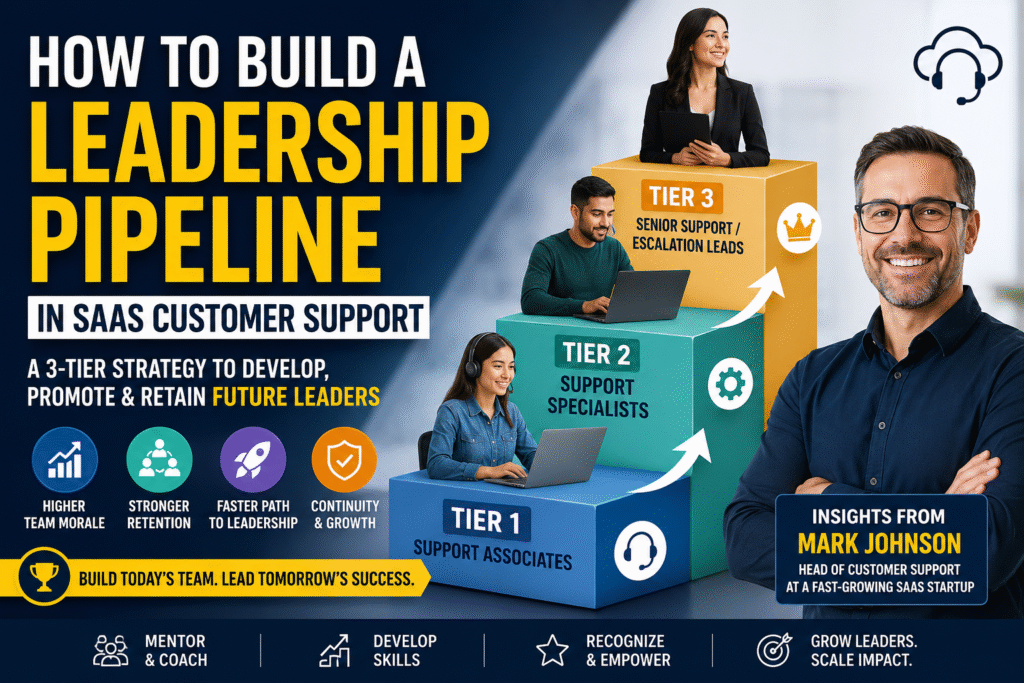
Scaling a SaaS business brings more customers, increased operational complexity, and a growing customer support workload. While expanding the support team is necessary, building a strong leadership pipeline is what creates long-term stability and scalability.
A high-performing SaaS support organization should not function as just a reactive help desk. It should operate as a structured environment where future Team Leads, Managers, and Operations Leaders are continuously developed from within. One strong example of this approach comes from Mark Johnson, Head of Customer Support at a rapidly growing SaaS company, who intentionally designed his support organization to develop future leaders at every level.
Why Building a Leadership Pipeline Matters
Hiring experienced managers externally can help fill immediate gaps, but organizations that promote internally often build stronger, more sustainable teams.
Higher Team Morale and Ownership
When support agents clearly see opportunities for career advancement, engagement naturally increases. Employees become more invested in learning, collaborating, and improving performance because growth feels achievable. Internal promotions also reinforce the idea that the company values contribution, consistency, and initiative—not just external experience.
This creates a stronger culture of accountability, ownership, and ambition across the support organization.
Faster Leadership Readiness
Internal promotions significantly reduce onboarding and ramp-up time because employees already:
- Understand the product and customer workflows
- Know common customer pain points
- Are familiar with internal systems and processes
- Have experience working with Product, Engineering, and Customer Success teams
- Understand company culture and communication styles
Instead of spending months learning the business, internally promoted leaders can focus immediately on execution and team development.
Better Continuity in Processes and Culture
External leadership hires can sometimes unintentionally disrupt established workflows and team dynamics. Leaders who grow internally are better positioned to improve processes while preserving what already works.
They understand:
- Existing operational challenges
- Team collaboration patterns
- Knowledge-sharing habits
- Customer communication standards
- Internal expectations across departments
Because they already have trust and credibility within the organization, they can implement change more effectively and with stronger team alignment.
Improved Retention and Loyalty
One of the most common reasons strong support agents leave SaaS companies is the absence of visible career growth.
A structured leadership pipeline changes this dynamic completely.
When support professionals can clearly see a path from Tier 1 to Tier 3—and eventually into leadership—they are more likely to stay, invest in learning, and contribute long term. Career progression becomes part of the support culture rather than an exception.
The 3-Tier SaaS Support Structure and Leadership Growth Strategy
Tier 1 (T1): The Foundation – Support Associates
Tier 1 support agents manage high-volume and lower-complexity interactions such as:
- Password resets
- Basic troubleshooting
- Subscription questions
- Product navigation assistance
The primary objective at this level is to identify individuals who demonstrate:
- Curiosity
- Initiative
- Team collaboration
- Strong communication skills
- A willingness to learn
Example: Ronnie’s Early Growth
Ronnie joined the support organization directly after college. Within his first three months, he consistently demonstrated initiative beyond his assigned responsibilities.
He recognized that many new Tier 1 agents struggled with recurring customer scenarios that were not fully covered during onboarding. Instead of simply adapting personally, Ronnie began creating internal documentation to improve the onboarding experience for future hires.
Internal Resources Ronnie Built
“Top 20 Common Tickets” Guide
Ronnie created a searchable internal guide inside the support CRM that included:
- Step-by-step troubleshooting instructions
- Platform screenshots
- Relevant help center links
- CRM macros
- Guidance for personalizing customer responses
The guide covered common issues such as:
- Password reset failures
- Mid-cycle subscription upgrades
- Missing tasks or permissions-related confusion
Troubleshooting Cheat Sheets
He also created quick-reference diagnostic guides to help agents determine:
- When an issue could be resolved immediately
- When escalation to Product or Engineering was necessary
- Common first-level troubleshooting steps
Live Chat Communication Guidelines
Ronnie developed tone and communication guidelines for newer agents, emphasizing:
- Empathy-first communication
- Clear and simple language
- Proper customer reassurance techniques
- Consistent ticket closure practices
“What I Wish I Knew in Week 1” Knowledge Hub
He later expanded these efforts into a centralized onboarding resource that included:
- CRM shortcuts
- Internal Slack channels
- Productivity tips during ticket surges
- Workflow best practices
Learning Beyond Support Tickets
Ronnie also volunteered to shadow Customer Success onboarding calls, despite this not being part of his formal responsibilities.
His goal was to better understand:
- Customer expectations during onboarding
- Common points of confusion
- Product adoption challenges
- Gaps between onboarding and support experiences
During these sessions, Ronnie identified several recurring operational issues.
Key Insights He Identified
Permission Confusion
Many customers misunderstood role-based access controls, resulting in repetitive support tickets.
Ronnie proposed:
- Pre-written macros explaining permissions
- Visual onboarding examples
- Improvements to onboarding communication
Gaps in Self-Serve Onboarding
Smaller customers who only received video onboarding frequently opened avoidable support tickets related to setup.
Ronnie recommended:
- An in-app setup checklist
- Guided onboarding steps for new users
The Product and CS teams later implemented these suggestions.
Terminology Misalignment
Customers heard one set of terms during onboarding but encountered different terminology inside the platform itself.
Ronnie escalated this issue to Product and Documentation teams, resulting in updated UI terminology for consistency.
Supporting Teammates and Developing Leadership Skills
Beyond customer interactions, Ronnie regularly helped teammates resolve difficult support cases.
Examples of Peer Leadership
Debugging a Notification Bug
When another agent struggled to reproduce a duplicate notification issue, Ronnie:
- Tested workflows in a sandbox environment
- Identified the trigger conditions
- Proposed a temporary workaround
- Documented the issue internally for future reference
Coaching on VIP Customer Communication
Ronnie also helped teammates manage difficult customer conversations by:
- Reframing responses with empathy
- Improving communication structure
- Encouraging proactive follow-ups
Sharing Internal Workflow Guidance
During high-volume periods, Ronnie frequently shared:
- Process walkthroughs
- Internal tool instructions
- Escalation guidance
- Slack snippets for faster ticket handling
These actions positioned him as an informal mentor within the team.
Mark Johnson recognized Ronnie’s initiative, collaboration skills, and operational thinking. Over time, Ronnie began receiving Tier 2 shadow responsibilities and eventually became a leading candidate for promotion.
Tier 2 (T2): The Core – Support Specialists
Tier 2 specialists handle:
- Advanced troubleshooting
- Escalations
- Technical investigations
- Cross-functional coordination with Product and Engineering
At this stage, leadership potential becomes increasingly important.
Strong Tier 2 agents demonstrate:
- Problem-solving ability
- Process ownership
- Mentorship skills
- Strategic thinking
- Cross-team collaboration
Ronnie’s Transition Into Tier 2
After being promoted, Ronnie contributed to several operational improvements, including:
- Building automated ticket-routing workflows
- Creating recurring feedback loops with Product teams
- Training and mentoring new Tier 1 agents
His responsibilities expanded beyond ticket handling into process improvement and team development.
To further prepare him for leadership, Mark assigned Ronnie a quarterly project focused on redesigning the onboarding experience for new support hires. This gave him exposure to:
- Cross-functional collaboration
- Project ownership
- Operational planning
- Change management
Tier 3 (T3): The Leadership Track – Senior Support and Escalation Leads
Tier 3 professionals manage:
- Enterprise escalations
- Critical incidents
- VIP customer relationships
- Operational improvements
- Knowledge management initiatives
This level serves as the primary leadership pipeline for future:
- Team Leads
- Support Managers
- Operations Leaders
Example: Jason’s Leadership Growth
When a senior support agent transitioned into a Product role, Mark promoted Jason from Tier 2 into Tier 3.
Jason quickly demonstrated leadership capability by:
- Leading Quarterly Business Reviews (QBRs) for enterprise accounts
- Implementing a new Engineering triage process
- Reducing incident response times by 20%
- Mentoring Tier 2 specialists preparing for Tier 3 readiness
Eventually, Jason became Team Lead for Strategic Support, managing a team while partnering closely with Support and Customer Success leadership to improve retention and operational performance.
Building a Backup Culture
One of Mark Johnson’s core leadership principles was simple:
Always have a promotion-ready successor at every level.
In his support organization:
- A Tier 1 agent should always be developing toward Tier 2 readiness
- A Tier 2 specialist should always be preparing for Tier 3 responsibilities
- A Tier 3 leader should be capable of stepping into management responsibilities
This approach ensured operational continuity, reduced leadership gaps, and created a strong internal growth culture.
By intentionally investing in mentorship, operational exposure, and career progression at every support tier, SaaS companies can transform their customer support organization into a long-term leadership engine that drives scalability, retention, and customer success.
Continue Your Learning Journey
Prefer learning at your own pace?
You can also take the Udemy version of this course, perfect for self-paced learners: Support Team Leader Mastery Bestseller Course on Udemy.
It’s packed with real-world examples, leadership templates, and proven coaching frameworks.Remember:
“Leadership is not about being in charge. It’s about taking care of those in your charge.” Ready to lead with clarity, confidence, and capability?
[Get Certified Now] and fast-track your support leadership career.

Govindraj Shetty is a customer support and success leader with over 19 years of experience across global organizations. He has built and scaled high-performing support and customer success teams, most notably at Yapsody, where he established departments and programs that consistently delivered strong customer satisfaction and client retention.
He is a trainer, Udemy instructor, and founder of The Customer Support School, and the author to customer support books.
