
Imagine this.
A customer who has trusted your SaaS platform to run their entire business calls your support team at 8:30 AM.
“None of our customers can complete a purchase. We have a product launch in two hours.”
Your frontline support agent knows the issue isn’t a simple password reset or configuration problem. It involves payment processing, API logs, third-party integrations, and multiple internal teams.
This is the moment where Escalation Management in SaaS determines whether the customer becomes your biggest advocate—or starts evaluating your competitors.
Many companies believe escalation simply means forwarding a ticket to Engineering. In reality, effective escalation management is much more than transferring ownership. It is about orchestrating people, processes, communication, accountability, and urgency while ensuring the customer never feels abandoned.
This article explores how SaaS companies can build a world-class escalation management process that reduces resolution time, improves customer confidence, and strengthens long-term relationships.
What is Escalation Management in SaaS?
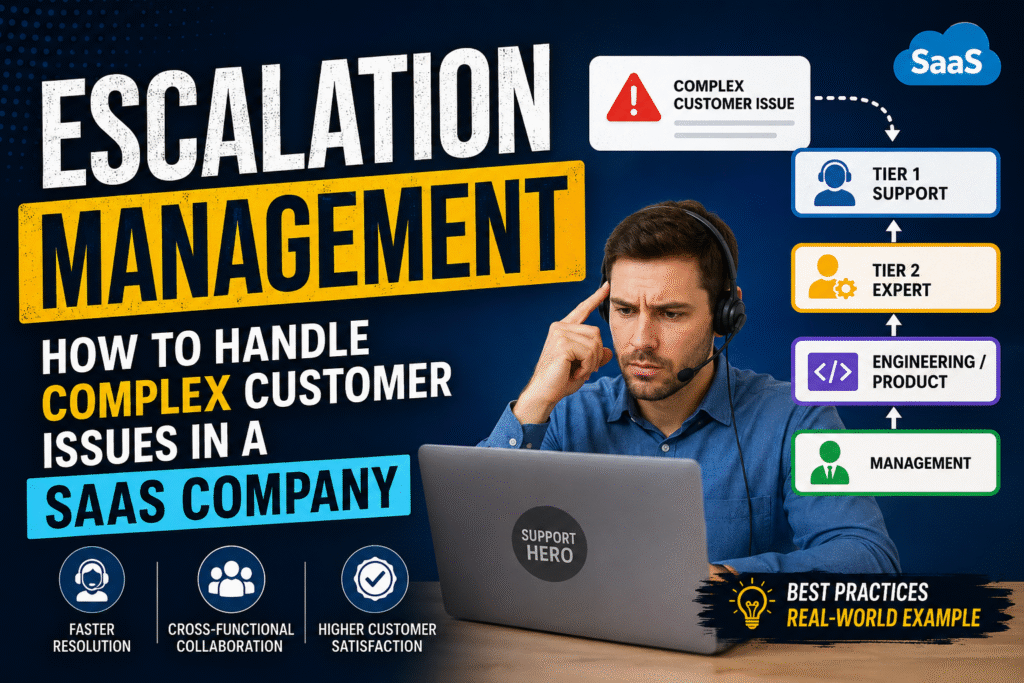
Escalation Management in SaaS is the structured process of transferring complex customer issues to the appropriate level of expertise, authority, or department when they cannot be resolved by frontline customer support. An escalation should never be viewed as a support failure. Instead, it is a carefully designed process that ensures the right experts become involved before the customer’s business suffers. Most SaaS organizations categorize escalations into three major types:Functional Escalation
The issue requires assistance from another department. Examples include:- Engineering investigating a software defect
- Finance resolving invoice discrepancies
- Security reviewing suspicious account activity
- Product team validating feature behavior
Hierarchical Escalation
The issue requires management involvement because of business impact or customer sensitivity. Examples include:- Executive customers requesting immediate attention
- Legal concerns
- SLA violations
- Contract disputes
Priority-Based Escalation
Some incidents demand immediate action regardless of ownership. Examples include:- Platform outages
- Data corruption
- Security breaches
- Payment failures
- Performance degradation affecting multiple customers
Why Escalation Management Matters More in SaaS Than Other Industries
Unlike traditional software businesses, SaaS companies rely on recurring subscriptions. Customers don’t buy your software once. They decide every month—or every year—whether to continue paying for it. A poorly handled escalation doesn’t simply create one unhappy customer. It can lead to:- Subscription cancellations
- Negative online reviews
- Lost expansion revenue
- Reduced customer lifetime value
- Damaged brand reputation
- Increased support costs
Common Reasons Customers Escalate Issues
Although every SaaS business is unique, most escalations fall into predictable categories.Technical Issues
Examples include:- Application crashes
- Slow performance
- API failures
- Authentication problems
- Database synchronization issues
Integration Failures
Modern SaaS products integrate with dozens of third-party applications. Common integrations include:- Salesforce
- HubSpot
- Stripe
- Microsoft 365
- Google Workspace
Billing Disputes
Examples include:- Incorrect invoices
- Duplicate charges
- Subscription downgrades
- Refund requests
Product Defects
Sometimes customers discover bugs that only appear under very specific conditions. These often require engineering investigation.Security and Compliance
Examples include:- Unauthorized access
- GDPR requests
- Data deletion
- Security incidents
The Seven-Step Escalation Framework Every SaaS Company Should Follow
Step 1: Identify Escalation Criteria
Support teams should never rely on instinct alone. Create predefined rules. Examples include:- Issue impacts more than 20 customers
- Customer cannot use a core feature
- SLA breach risk
- High-value enterprise account
- Security concern
- No resolution after four hours
Step 2: Gather Complete Information
One of the biggest reasons escalations slow down is missing information. Before escalating, collect:- Customer details
- Screenshots
- Error messages
- Browser information
- Device information
- API logs
- Steps to reproduce
- Business impact
Step 3: Escalate with Context
Don’t simply write: “Engineering, please investigate.” Instead include: Problem Customer cannot sync opportunities from Salesforce. Impact Sales team unable to generate reports. Priority P1 Troubleshooting Completed- Cache cleared
- OAuth token renewed
- API connection tested
- Integration reinstalled
- Error logs
- Screenshots
- HAR file
- Integration ID
Step 4: Keep the Customer Updated
One of the biggest mistakes SaaS companies make is becoming silent after escalation. Customers assume nothing is happening. Even if there is no new technical update, communicate regularly. For example: “Our engineering team has identified the issue and is actively working on a fix. Your next update will be shared within two hours.” Frequent communication builds confidence. Silence destroys trust.Step 5: Coordinate Cross-Functional Teams
Complex issues often involve multiple departments. A single escalation may require:- Customer Support
- Engineering
- DevOps
- Product Management
- Customer Success
- Finance
- Security
Step 6: Resolve and Validate
Once the fix is deployed:- Confirm the issue is resolved
- Test internally
- Ask the customer to verify
- Monitor for recurring issues
Step 7: Conduct a Post-Escalation Review
Every major escalation should improve the organization. Ask:- Why did this happen?
- Could support have detected it sooner?
- Should monitoring improve?
- Can documentation be updated?
- Does the knowledge base need enhancement?
- Can automation prevent similar incidents?
Real-World Example: Managing a High-Impact SaaS Escalation
Let’s walk through a realistic scenario.Company
A cloud-based project management platform.Customer
A multinational enterprise with over 12,000 employees.Problem
The company’s Salesforce integration suddenly stops syncing customer opportunities. Without synchronization:- Executives cannot generate reports.
- Sales forecasts become inaccurate.
- Multiple departments lose visibility.
Phase 1: Initial Response
Tier 1 Support responds within minutes. The agent:- Verifies account health
- Checks integration status
- Reviews logs
- Confirms widespread failure
Phase 2: Engineering Escalation
Support prepares a detailed escalation package including:- Timeline
- Error logs
- Customer impact
- API responses
- Integration identifiers
- Previous troubleshooting
Phase 3: Customer Communication
Instead of saying, “We’re looking into it.” Support communicates: “Our Engineering team has classified this as a Priority 1 incident. We will provide updates every two hours until the issue is fully resolved.” Notice the difference. The customer now knows:- Ownership
- Priority
- Communication frequency
Phase 4: Root Cause
Engineering discovers Salesforce modified one API schema overnight. The integration validation process failed unexpectedly. A hotfix is developed.Phase 5: Resolution
Within four hours:- Hotfix deployed
- Sync resumes
- Historical records reprocessed
- Monitoring enabled
Phase 6: Internal Learning
The incident review identifies improvements:- API monitoring enhancements
- Automated compatibility testing
- Knowledge Base updates
- Engineering alerting improvements
- Improved release validation
Best Practices for Outstanding Escalation Management
High-performing SaaS companies consistently follow these practices:- Define clear escalation criteria.
- Maintain an up-to-date escalation matrix.
- Train support teams on technical and communication skills.
- Integrate ticketing platforms with collaboration tools.
- Assign a single owner for every escalation.
- Communicate proactively with customers.
- Conduct root cause analysis after every major incident.
- Continuously update internal documentation and knowledge bases.
Key Metrics Every Support Leader Should Monitor
If you cannot measure escalation performance, you cannot improve it. Track these KPIs regularly:- Percentage of escalated tickets resolved within SLA with customers
- Percentage of escalated tickets resolved within OLA with department
- Average Resolution Time for escalated cases
- Escalation Rate by support channel
- Customer Satisfaction (CSAT) of those Escalated cases
Final Thoughts
Exceptional customer support isn’t measured by how many tickets your team closes—it is measured by how confidently your organization handles the most difficult customer situations. Every SaaS company experiences software defects, integration failures, billing issues, and unexpected incidents. What separates great companies from average ones is not the absence of problems but the quality of their Escalation Management in SaaS process. A well-designed escalation framework ensures customers always know who owns their issue, what is happening behind the scenes, and when they can expect the next update. Internally, it creates accountability, reduces resolution time, improves collaboration across departments, and turns every major incident into an opportunity for continuous improvement. If your support team can consistently deliver that experience, escalations will no longer be viewed as emergencies—they will become moments that strengthen customer trust and reinforce your reputation as a reliable SaaS partner.Continue Your Learning Journey
Prefer learning at your own pace? You can also take the Udemy version of this course, perfect for self-paced learners: Support Team Leader Mastery Bestseller Course on Udemy. It’s packed with real-world examples, leadership templates, and proven coaching frameworks.Remember: “Leadership is not about being in charge. It’s about taking care of those in your charge.” Ready to lead with clarity, confidence, and capability? [Get Certified Now] and fast-track your support leadership career.
Govindraj Shetty is a customer support and success leader with over 19 years of experience across global organizations. He has built and scaled high-performing support and customer success teams, most notably at Yapsody, where he established departments and programs that consistently delivered strong customer satisfaction and client retention.
He is a trainer, Udemy instructor, and founder of The Customer Support School, and the author to customer support books.
