
In many SaaS companies, Customer Support and Customer Success are treated as two completely separate functions.
Support Agents solve problems.
Customer Success Managers drive adoption, retention, renewals, and expansion.
At least, that is how the org chart often looks.
But the customer does not experience your company through an org chart.
A customer may open a support ticket because they cannot configure a feature, discover during the conversation that they are not using an important capability, and then mention that they are considering another solution because they are not getting enough value from the platform.
The Support Agent is suddenly sitting on information that could directly affect customer retention and revenue.
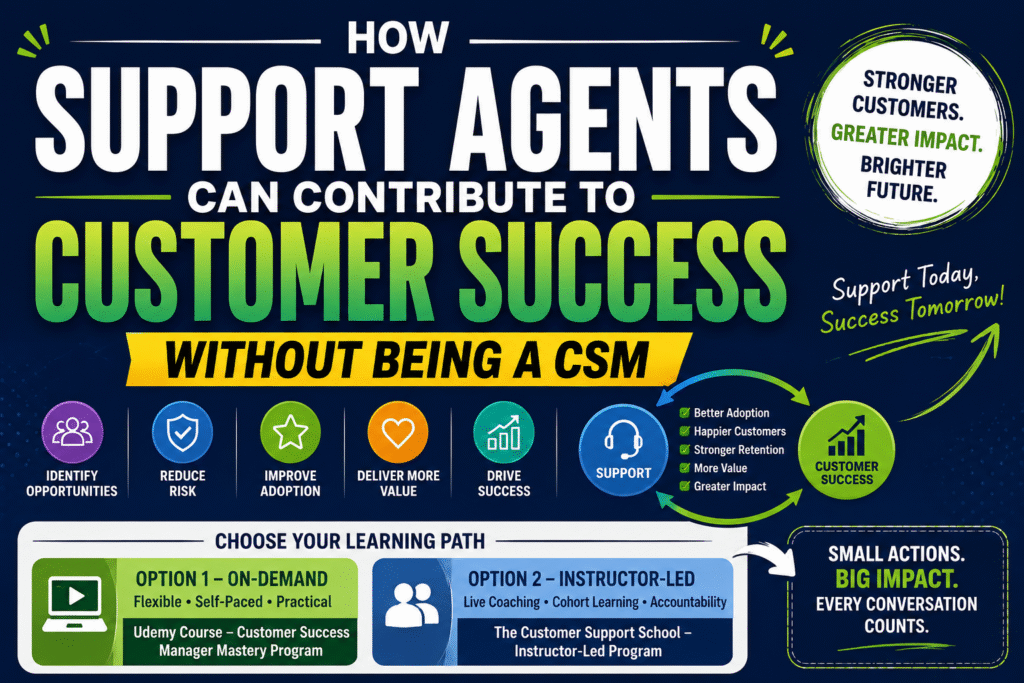
This is where Support Agents can make a meaningful contribution to Customer Success—without becoming a CSM.
The goal is not to turn every Support Agent into a salesperson or make them responsible for renewals.
The goal is to help Support Agents recognize opportunities to create customer value, identify risk, improve adoption, and provide intelligence to the Customer Success team.
Support and Customer Success Have Different Jobs—But the Same Customer
Customer Support is primarily focused on helping customers resolve problems and successfully use the product.
Customer Success takes a broader view of the customer’s journey and business outcomes.
A simple way to look at the difference is:
Support asks:
“How can I solve this problem?”
Customer Success asks:
“How can we help this customer achieve their desired outcome?”
Both questions are important.
In SaaS, however, the answer to the first question can often reveal information that helps answer the second.
For example, imagine a customer contacts support because they cannot create a report.
A traditional support interaction might be:
Customer: “I can’t create this report.”
Agent: “Here’s how you create it.”
Problem solved.
A Customer Success-oriented support interaction goes one step further:
“Here’s how you can create the report. I also noticed you’re trying to track customer conversion. This report can help you monitor that. Would you like me to share the recommended setup?”
The Agent has still solved the support issue—but has also helped the customer understand the business value of the feature.
That is Customer Success thinking.
Why Support Agents Are Uniquely Positioned to Influence Customer Success
Support teams often have more customer conversations than any other customer-facing department.
That creates a significant advantage.
Support Agents hear:
- What customers are struggling with
- Which features they don’t understand
- What prevents adoption
- Why customers become frustrated
- What competitors customers mention
- What customers expect from the product
- Which workflows are creating friction
- What customers value most
- What customers are considering buying
- Why customers may be at risk of leaving
This makes Support a valuable source of customer intelligence.
Zendesk describes SaaS support as extending beyond basic issue resolution to helping customers understand and use the product effectively, which can support adoption and retention.
HubSpot similarly emphasizes the importance of connecting customer support information with Customer Success so CSMs can understand the broader context of customer interactions and support history.
The opportunity, therefore, is not to blur the responsibilities of Support and Success.
It is to connect them better.
7 Ways Support Agents Can Contribute to Customer Success
1. Identify Adoption Opportunities
One of the easiest ways Support Agents can contribute to Customer Success is by recognizing when a customer is not fully using the product.
Suppose a customer has been using a SaaS platform for six months but only uses two of ten major features.
During a support conversation, the Agent discovers that the customer is manually performing a task that could be automated with an existing feature.
Instead of simply answering the original question, the Agent can say:
“There is actually a feature that can automate this process. Based on what you’re trying to accomplish, it may save your team quite a bit of time.”
That is not selling.
It is helping the customer get more value from something they already purchased.
The Agent can then record the opportunity or notify the CSM.
Support-to-Success signal:
Customer is struggling with a process → Agent identifies an unused capability → Customer learns how to get more value → CSM follows up if necessary.
This creates a simple bridge between Support and Success.
2. Recognize Customer Health Signals
Support Agents can become an important early-warning system for customer risk.
A single support ticket does not necessarily mean a customer is unhappy.
But patterns matter.
Consider a customer who:
- Has submitted five tickets in two weeks
- Repeatedly reports the same problem
- Is frustrated with product limitations
- Mentions a competitor
- Says the product is becoming difficult to use
- Has stopped using an important feature
- Asks about cancellation or contract terms
Each individual interaction might look like a normal support request.
Together, they may indicate a customer at risk.
A Support Agent doesn’t need to own the recovery strategy.
They simply need to recognize the signal and escalate it appropriately.
For example:
Customer statement:
“We’ve had too many problems with this lately. We’re starting to look at other platforms.”
Support Agent action:
Resolve the immediate issue and flag the account to Customer Success.
CSM action:
Review the account, understand the underlying business concern, and develop a recovery plan.
This is one of the highest-value contributions Support can make.
3. Turn Support Conversations Into Product Feedback
Support tickets contain an enormous amount of product intelligence.
If ten customers independently ask how to accomplish the same task, that may indicate a usability problem.
If customers repeatedly request the same capability, Product may need to investigate it.
If customers consistently misunderstand a feature, the problem may not be the customer—it may be the product experience, documentation, or onboarding.
Support Agents can therefore help Customer Success by categorizing feedback into areas such as:
- Product limitation
- Usability issue
- Feature request
- Documentation gap
- Training opportunity
- Onboarding problem
- Customer expectation mismatch
This creates a feedback loop:
Customer → Support → Product/CS → Improvement → Customer
That loop can have a direct impact on retention.
HubSpot notes that customer support interactions can provide opportunities to understand customer needs, improve the product experience, and support renewal relationships.
4. Help Customers Discover More Value
Support Agents do not have to upsell to contribute to revenue.
They can simply help customers discover value.
For example, imagine a SaaS customer paying for a premium plan but only using basic functionality.
The Agent notices this during a support interaction.
Instead of saying:
“You should upgrade.”
The Agent can say:
“Your current plan includes this capability as well. Based on the workflow you described, you may find it useful.”
The difference is important.
The Agent is not forcing a commercial conversation.
They are helping the customer understand the value of the product they already have.
This can indirectly contribute to:
- Product adoption
- Retention
- Expansion
- Customer satisfaction
- Renewal probability
The CSM or Account Manager can then handle the commercial conversation when appropriate.
5. Create Better Handoffs to Customer Success
A weak handoff sounds like:
“Customer is unhappy. Please follow up.”
A strong handoff gives the CSM enough context to act.
For example:
Weak handoff:
Customer has an issue with reporting.
Strong handoff:
Customer is trying to use reporting to track event conversion. They currently export data manually every week. They were unaware that the automated reporting feature could accomplish this. I explained the basic functionality, but they may benefit from a short onboarding session with CS.
The second version is much more valuable.
The CSM immediately knows:
- What the customer is trying to achieve
- What problem they are experiencing
- What they currently do
- What feature may help
- What action may be appropriate
Good Support-to-CS handoffs reduce duplication and create a more connected customer experience.
6. Use Customer Language to Improve Customer Success
Support Agents often know how customers actually describe their problems.
That language is extremely valuable.
A CSM might describe an issue using internal terminology.
The customer may describe it completely differently.
For example:
Internal language:
“Customer has low adoption of automated workflow functionality.”
Customer language:
“My team still has to do this manually every Friday.”
The second statement is often more powerful because it explains the business impact.
Support Agents can help CSMs understand:
- What customers are actually trying to accomplish
- How customers describe value
- What terminology customers use
- What frustrations repeatedly appear
- What outcomes customers care about
This information can improve onboarding, QBRs, training, documentation, and customer communications.
7. Close the Loop With Customers
One of the simplest ways Support can contribute to Customer Success is by closing the loop.
Imagine a customer reports a recurring issue.
The issue is eventually fixed.
A transactional support experience says:
“The issue has been resolved.”
A customer-success-oriented experience says:
“The issue you reported has been resolved. Thank you for bringing it to our attention. Your feedback helped us identify the problem.”
That second message creates something important:
The customer sees that their feedback matters.
This can strengthen trust.
Customer Success is ultimately about helping customers achieve outcomes while building a relationship that makes them want to continue doing business with you.
Support plays a major role in that experience.
Real SaaS Examples
Zendesk: Support Can Influence the Broader Customer Experience
Zendesk itself provides a useful example of how SaaS support can extend beyond simply answering tickets.
Its SaaS customer support guidance emphasizes understanding the product deeply and helping customers use the software effectively for adoption and retention.
Zendesk also highlights Reverb as an example of a company using knowledgeable support agents, omnichannel capabilities, and personalization to deliver customer service. Reverb reported a 10x increase in self-service usage and a 97.6% CSAT after implementing the approach described by Zendesk.
The lesson for Support Agents is important:
Product knowledge is not just a ticket-resolution skill. It can become a customer-value skill.
A knowledgeable Agent can help a customer understand what the product can do—not merely explain what went wrong.
HubSpot: Connecting Support With Customer Success
HubSpot’s approach also demonstrates the importance of connecting support information with the broader customer relationship.
HubSpot explains that CRM systems allow Customer Success teams to see customer communication and support history, giving them greater context when working with customers.
For Support Agents, this means the ticket should not be viewed as an isolated transaction.
A ticket can become part of the customer’s overall story.
For example:
Ticket → Customer problem → Product usage insight → Customer health signal → CSM action
That is a much more powerful operating model than simply measuring how quickly the ticket was closed.
Slack: Support Expanding Beyond Traditional Support
Slack’s customer story featuring Accent Group provides another useful example of support becoming more connected to the broader customer journey.
Accent Group describes its support operation as supporting customers across presales, sales, and post-sale interactions, while also tracking its contribution to revenue and digital sales.
The broader lesson is significant:
Customer-facing teams don’t have to stay inside traditional functional boundaries to create business value.
Support can contribute to the customer journey without becoming the Sales or Customer Success department.
What Support Agents Should NOT Do
There is an important boundary.
Support Agents should not suddenly become responsible for everything a CSM does.
They don’t necessarily need to:
- Own renewals
- Run QBRs
- Manage customer health scores
- Negotiate contracts
- Own expansion targets
- Conduct executive business reviews
- Become account managers
Instead, their role can be:
Observe → Identify → Help → Document → Escalate → Close the loop
This allows Support to contribute to Customer Success without creating role confusion.
The Support Agent’s New Mindset
The biggest change isn’t a new process.
It is a new way of thinking.
A traditional Support Agent thinks:
“How do I close this ticket?”
A Customer-Success-oriented Support Agent thinks:
“How do I solve this problem and help the customer get more value?”
That doesn’t mean spending 30 minutes on every ticket.
It means recognizing the moments where a simple interaction can create additional customer value.
For example:
Reactive Support
Customer asks how to configure a feature.
Agent: Provides instructions.
Success-Oriented Support
Customer asks how to configure a feature.
Agent: Provides instructions, explains why the feature matters for the customer’s use case, identifies an adoption opportunity, and flags it for the CSM when appropriate.
Same ticket.
Different mindset.
How Managers Can Enable Support Agents
If you want Support Agents to contribute to Customer Success, don’t simply tell them to “be more proactive.”
Give them a framework.
Create clear triggers for when Support should notify Customer Success.
For example:
Customer Risk
- Customer mentions cancellation
- Customer mentions a competitor
- Repeated unresolved issues
- Significant frustration
- Declining product usage
Adoption Opportunity
- Customer isn’t using a key feature
- Customer is performing a process manually
- Customer asks how to achieve a broader business outcome
- Customer has purchased functionality they haven’t adopted
Expansion Opportunity
- Customer asks about additional capacity
- Customer asks about another product/module
- Customer explains a growing business requirement
- Customer needs functionality beyond their current plan
Strategic Feedback
- Repeated feature request
- Major usability problem
- Recurring workflow issue
- Product limitation affecting business outcomes
Then create a simple escalation process.
Support identifies the signal → documents the context → routes it to CS → CS takes ownership of the next step.
This makes Customer Success a company-wide responsibility rather than a department that operates in isolation.
The Bigger Career Opportunity for Support Agents
There is another important benefit.
Learning Customer Success concepts can expand a Support Agent’s career opportunities.
Support professionals already develop valuable skills:
- Product expertise
- Customer communication
- Problem solving
- Empathy
- Conflict management
- Customer relationship skills
- Cross-functional collaboration
What they may need to develop next is the ability to connect those skills to:
- Customer outcomes
- Product adoption
- Retention
- Churn prevention
- Customer health
- Business value
- Revenue
That is the transition from solving customer problems to helping customers achieve outcomes.
And for Support Agents interested in moving into Customer Success, this can become a powerful career path.
Final Thought: You Don’t Need the CSM Title to Practice Customer Success
Customer Success is not just a job title.
It is a way of thinking about the customer.
A Support Agent can contribute to Customer Success by recognizing adoption opportunities, identifying risk, sharing customer intelligence, improving product education, creating better handoffs, and helping customers understand the value of the product.
The CSM may own the customer relationship.
But the Support Agent can influence that relationship every single day.
The future of SaaS customer experience is not Support versus Customer Success.
It is Support + Customer Success + Product + Sales working together around the customer outcome.
And in many organizations, the Support Agent may already be one of the most important people in that equation.
Choose Your Learning Path
If you’re a Support Agent who wants to build Customer Success skills—or a Customer Success leader looking to develop Support professionals—the next step is learning how to turn these concepts into practical frameworks.
Choose the learning format that fits your career goals and learning style.
Option 1 — On-Demand Learning (Flexible & Self-Paced)
Designed for professionals who prefer to learn at their own pace with a structured roadmap.
The Customer Success Manager Mastery Program is designed specifically for Support professionals and aspiring CSMs who want to move from reactive support toward proactive Customer Success.
This program provides:
- Step-by-step modules
- Proven templates and scripts
- Real SaaS case studies
- A complete transition framework into Customer Success
- Customer journey mapping
- Adoption and retention strategies
- Churn prevention frameworks
- QBR and stakeholder management concepts
- Revenue and expansion strategies
The program covers the transition from Support to Customer Success, customer journey mapping, risk identification, retention, renewals, and expansion.
Customer Success Manager Mastery Program – On-Demand
Enroll here:
Udemy Course – Customer Success Manager Mastery Program
Option 2 — Instructor-Led Program (Live Coaching & Accountability)
Best suited for professionals who want guided learning with direct interaction and personalized feedback.
The Instructor-Led program is designed for professionals who want more than self-paced content.
This program includes:
- Live coaching sessions
- Cohort-based learning
- Real-time problem solving
- Accountability and performance tracking
- Personalized feedback
- Practical application of Customer Success frameworks
This format is particularly useful for professionals who want guidance while applying Customer Success concepts to real workplace situations.
Customer Success Manager Mastery – Instructor-Led Program
Join here:
The Customer Support School – Instructor-Led Program
Your Support Experience Is Already a Foundation
You don’t need to start your Customer Success career from zero.
If you’ve spent years helping customers, solving product problems, understanding customer frustrations, and building product expertise, you already have a strong foundation.
The next step is learning how to connect that experience to adoption, retention, customer outcomes, and revenue.
That’s where Support can become a powerful pathway into Customer Success.
Solve the problem. Understand the outcome. Identify the opportunity. Create customer value.
That’s Customer Success thinking—even when your job title still says Support Agent.

Govindraj Shetty is a customer support and success leader with over 19 years of experience across global organizations. He has built and scaled high-performing support and customer success teams, most notably at Yapsody, where he established departments and programs that consistently delivered strong customer satisfaction and client retention.
He is a trainer, Udemy instructor, and founder of The Customer Support School, and the author to customer support books.
