
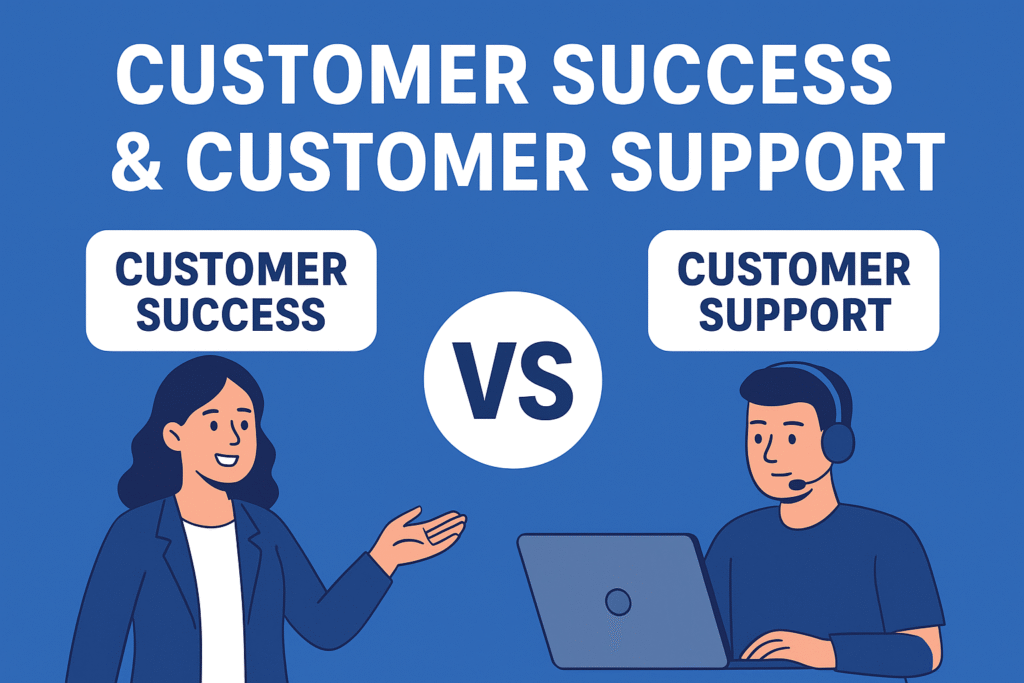
In the SaaS world, two teams directly influence customer satisfaction, retention, and lifetime value: Customer Support and Customer Success. While the titles sound similar, their responsibilities, strategies, and objectives are fundamentally different. And understanding these differences can reshape how you build teams, measure performance, and grow your customer base.
Whether you’re a support agent, team leader, manager, or founder, this deep-dive guide will help you clearly understand each function, with real-world examples and clarity that most companies miss.
Section 1: Support vs Success — The One-Line Difference
- Customer Support → Fixes problems. Support is reactive. Support solves today’s issue.
- Customer Success → Helps customers achieve outcomes. Success is proactive. Success ensures tomorrow’s growth.
This single distinction drives everything else: responsibilities, skills, metrics, and even hiring.
Section 2: What Customer Support Really Does (A Deep Practical Breakdown)
Customer Support is the first line of defense. When users need help, face issues, don’t understand a feature, or experience system limitations, support steps in.
Core Responsibilities of Customer Support
A mature support team typically handles:
- Troubleshooting issues through chat, email, or phone
- Answering “how to” questions
- Escalating bugs to the product team
- Ensuring SLA response and resolution times
- Creating and updating help articles
- Communicating during incidents or downtimes
- Improving CSAT and ticket quality
- Managing high-pressure situations calmly
Support agents must combine technical knowledge, empathy, patience, and clear communication under pressure.
Real-World Scenario 1: Ticket Scanning Problem at a Live Event
Problem:
A presenter is scanning tickets at the event gate. Every QR code shows “Invalid Ticket.”
Customer Support Response:
- Verify event and ticket type
- Check scanner version
- Walk them through syncing data
- Identify a possible misconfiguration
- Fix the issue in real time
- Capture logs and escalate if required
Outcome:
Scanning resumes instantly, preventing chaos at the venue.
This is classic support work—solving a crisis under pressure.
Real-World Scenario 2: Payment Failure During Ticket Purchase
Problem:
A customer repeatedly gets “Payment Failed.”
Support Steps:
- Check gateway logs
- Validate card rejection reasons
- Suggest alternate payment methods
- Guide the user step-by-step
- Escalate to payment gateway if needed
Support’s job ends once the issue is solved. There’s no long-term engagement or planning involved.
Section 3: What Customer Success Really Does (A Strategic Function)
Customer Success takes a long-term relationship approach. Their job starts after a customer begins using the product. Their role is to ensure customers achieve results, adopt features, and ultimately renew and expand.
Core Responsibilities of Customer Success
- Onboarding new customers
- Driving adoption of key features
- Monitoring usage and health score
- Conducting QBRs
- Identifying upsell and expansion opportunities
- Creating customer success plans
- Preventing churn proactively
- Working closely with product, sales, and support
Customer Success isn’t about fixing short-term issues—it’s about ensuring long-term value and revenue growth.
Real-World Scenario 1: New Customer Uses Only Basic Features
A new event presenter uses only the basic ticket creation functionality.
What the CSM does:
- Conducts onboarding
- Understands their event type and goals
- Recommends add-ons, email campaigns, access management, group scanning
- Creates a customized success plan
- Tracks adoption
- Reviews performance before the event
Outcome:
With better usage, the presenter increases ticket revenue.
Real-World Scenario 2: Drop in Customer Activity (Early Churn Warning)
A customer who previously hosted multiple events stops using the platform.
What the CSM does:
- Reviews usage metrics
- Schedules a strategic meeting
- Understands internal changes or new challenges
- Provides optimization strategies
- Re-activates their usage
- Saves the account long before renewal
This showcases the proactive, revenue-growing mindset of Customer Success.
Section 4: Detailed Comparison — Support vs Success
| Category | Customer Support | Customer Success |
| Approach | Reactive | Proactive |
| Goal | Fix issues | Drive outcomes |
| Timeline | Short-term | Long-term |
| Success Metric | CSAT, AHT, SLA | Renewal, Adoption, Expansion |
| Trigger | Customer reports a problem | CSM initiates engagement |
| Focus | Issue resolution | Customer growth |
| Nature of Work | Tactical | Strategic |
| Internal Positioning | Cost-centre perception | Revenue-centre perception |
Both roles are essential, but Customer Success is directly tied to revenue—renewals, upsells, and reducing churn.
This is why companies pay more and expect greater business acumen from CSM roles.
Section 5: How Support & Success Collaborate (Real Examples)
Example: Slow Ticket Scanning Issue
- Support → Fixes the issue immediately
- Success → Reviews the impact, creates a prevention plan, advises on optimal setup
Example: Event Isn’t Selling Tickets
- Support → Helps with setting up discounts
- Success → Creates a sales funnel plan, marketing recommendations, and adoption strategy
Example: Feature Request
- Support → Logs the request
- Success → Validates revenue impact, discusses in roadmap meetings
Collaboration creates a complete customer experience.
Section 6: Why Many Companies Fail — Mixing Both Roles
Startups often combine support and success into one role due to lack of resources. But this eventually leads to:
❌ Burnout
❌ No proactive adoption
❌ Rising churn
❌ Poor onboarding
❌ No renewals strategy
❌ Confusion in expectations
As companies scale, they quickly realize that these roles must be separated because the mindset, metrics, and goals are completely different.
Section 7: Why Playbooks Matter (The Foundation of Both Teams)
Support Playbooks
- Chat opening & closing scripts
- Escalation framework
- Incident communication templates
- Troubleshooting workflows
- CSAT improvement templates
Success Playbooks
- Onboarding framework
- 30-60-90 day adoption map
- Renewal process
- Upsell scripts
- QBR templates
- Churn prevention playbook
Inside your program, these are explained step-by-step with ready-to-use documents.
Section 8: Final Thoughts — Two Teams, One Mission
Customer Support protects the customer experience today.
Customer Success protects the customer’s journey tomorrow.
Support = stability.
Success = growth.
A mature SaaS business needs both.
But the career paths and strategic impact are very different.
Section 9 (New): Ready to Move from Support to Customer Success?
This is the part that many support agents secretly think about but rarely talk publicly:
“I’ve been in support for 5+ years… What’s next for me?”
“Support salaries are limited… How do I grow my career?”
“I want a role that involves strategy, revenue, and customer relationships.”
If this sounds familiar, you’re not alone.
Thousands of support agents face a career ceiling.
They learn everything about the product, manage difficult customers, multitask every day—but don’t get growth opportunities.
And here’s the truth:
Customer Success is the natural promotion path for experienced support agents.
Why?
Because CSMs:
- Handle revenue
- Lead business conversations
- Manage renewals
- Play a strategic role
- Earn higher salaries
- Enjoy leadership visibility
- Directly impact company growth
If you’ve been in support for 3 to 10 years, you already have:
- Product depth
- Customer empathy
- Problem-solving
- Communication skills
- Understanding of user behavior
All you need is the CS skills, frameworks, and playbooks to transition into the role.
Choose Your Learning Path: Instructor-Led or On-Demand
Whether you prefer hands-on coaching or flexible self-paced learning, both pathways are available for you.
OPTION 1 — On-Demand (Learn Anytime, Master Everything at Your Pace)
Perfect for professionals who want a complete transition roadmap with step-by-step modules, templates, scripts, and case studies.
👉 Customer Success Manager Mastery Program – On-Demand
Enroll here:
https://www.udemy.com/course/customer-success-manager-mastery-program/learn/?referralCode=6AA6334F9FAFB1CA31F5
OPTION 2 — Instructor-Led (Deep Coaching + Live Guidance)
Ideal for those who want direct interaction, personalized feedback, community support, and live cohort-based learning.
👉 Customer Success Manager Mastery – Instructor-Led Program
Join the instructor-led version:
https://thecustomersupportschool.com/tcss-customer-success-manager-mastery/

Govindraj Shetty is a customer support and success leader with over 19 years of experience across global organizations. He has built and scaled high-performing support and customer success teams, most notably at Yapsody, where he established departments and programs that consistently delivered strong customer satisfaction and client retention.
He is a trainer, Udemy instructor, and founder of The Customer Support School, and the author to customer support books.
